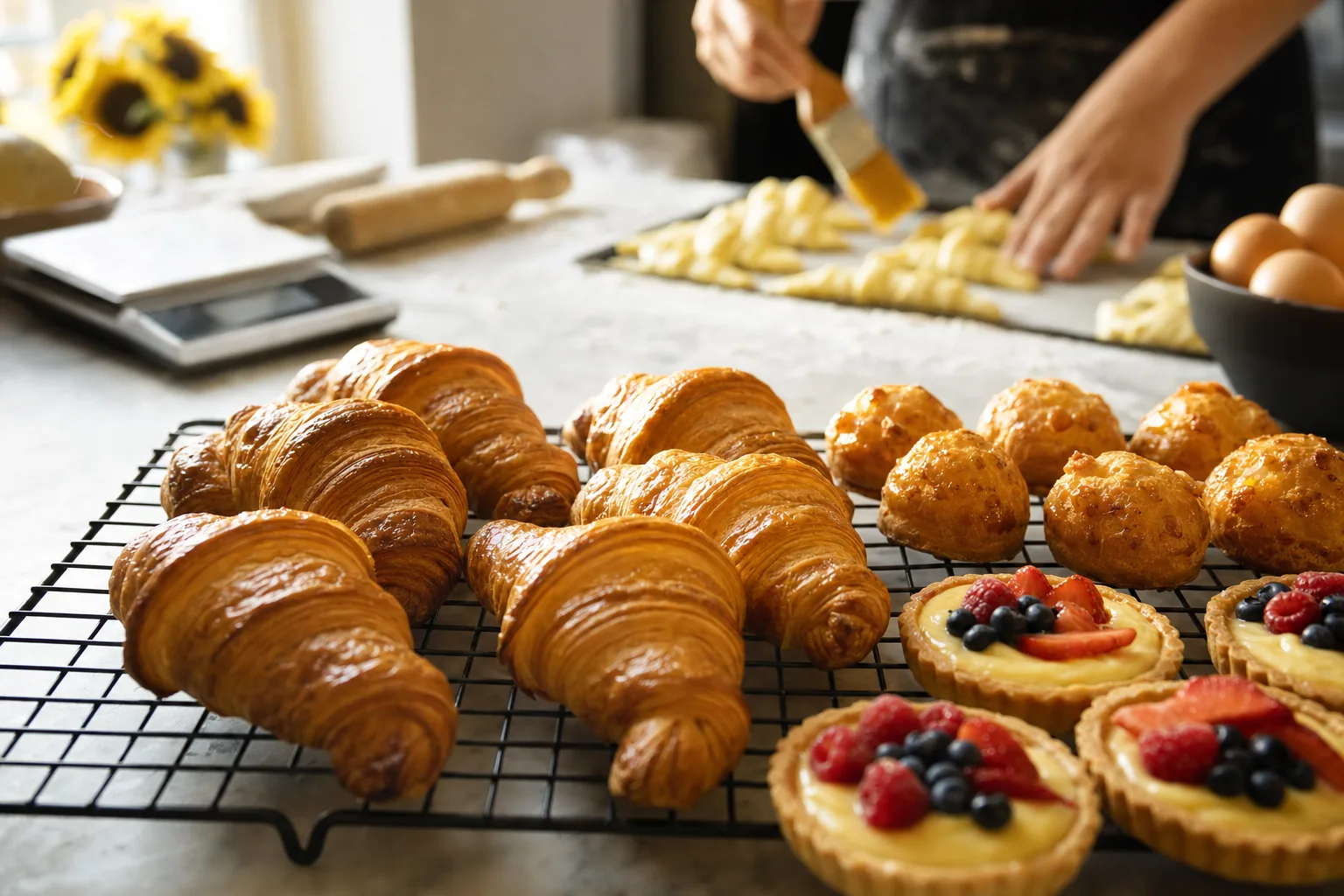
Weigh everything: precision is the foundation
Pastry is less forgiving than savory cooking. A sauce can be adjusted at the stove; a cake cannot be fixed once it is in the oven. The foundation of consistent pastry is weighing every ingredient, including liquids and eggs, in grams. A cup of flour can vary widely in weight depending on how it is scooped, which is enough to turn a tender cake into a dry one.
Use a digital scale with one-gram resolution for most ingredients and a precision scale reading to a tenth of a gram for yeast, salt, leaveners and gelatin. Write recipes in grams, and consider baker’s percentages, where every ingredient is expressed as a percentage of the flour weight. Baker’s percentages make scaling simple and let experienced staff spot a recipe error at a glance.
Weighing also makes costing and ordering accurate. When every recipe is in grams, you can calculate exactly how much butter, flour and sugar the week’s production needs. It also simplifies training. A new hire can follow a gram-based recipe on day one, and a supervisor can check a batch by weighing the bowl rather than trusting memory. Keep scales on every pastry bench, calibrate them regularly with a known weight and replace any that drift.
Flour and protein content
Flour proteins form gluten when they are hydrated and worked. More protein and more mixing give a stronger, chewier structure; less protein and gentle handling give tenderness. Choosing the right flour is the first step in controlling texture, and protein percentage, printed on most professional flour bags, is the best guide. Most cafes need only two or three flours, known well.
Names and protein levels vary between countries and mills. Indian maida is a refined flour often used like all-purpose flour, but its protein varies by brand, so check the specification and test it in your recipes. Whole wheat atta behaves very differently from white flour because the bran cuts gluten strands and absorbs more water. Note the brand you tested in each recipe.
| Flour | Typical protein | Best for |
|---|---|---|
| Cake flour | About 7 to 9% | Sponges, chiffon cakes, tender crumbs |
| Pastry flour | About 8 to 10% | Pie dough, tart shells, biscuits, muffins |
| All-purpose or maida | About 10 to 12%, varies by mill | Cookies, choux, general baking |
| Bread flour | About 12 to 14% | Croissant and brioche dough, breads |
| Whole wheat or atta | Varies; bran affects gluten | Rustic breads, parathas, blended into doughs |
Butter temperature controls texture
Butter is roughly eighty to eighty-two percent fat in most standard products and a little higher in many European-style butters, with the remainder mostly water. The temperature of that fat decides how it behaves in a dough or batter, and it is the variable cafes most often fail to control, especially in warm kitchens. A simple probe thermometer is the best tool for it.
Cold butter for flaky pastry
In pie and tart doughs, cold butter stays in distinct pieces coated with flour. In the oven, its water turns to steam and lifts the layers, creating flakiness. Keep butter at refrigerator temperature, work quickly, and chill the dough before rolling. If the butter softens and smears into the flour, the pastry becomes tough and greasy rather than flaky. Rest it again before baking.
Plastic butter for lamination
For croissant and puff pastry, butter must be cold but pliable so it stretches in sheets without cracking or melting, generally around 13 to 16 degrees Celsius. The dough and butter should be at a similar firmness. Butter that is too cold shatters into pieces; butter that is too warm melts into the dough and the layers disappear. Check it by bending a corner.
Soft butter for creaming
For cakes and cookies made by creaming, butter at around 18 to 20 degrees is soft enough to trap air when beaten with sugar yet firm enough to hold it. Melted or very soft butter cannot hold air, giving dense cakes and cookies that spread too far. Cut cold butter into small cubes and let it stand for twenty to thirty minutes rather than softening it in a microwave, which melts it unevenly.
Laminated doughs: croissant and puff pastry
Lamination creates hundreds of alternating layers of dough and butter through repeated rolling and folding. In the oven, steam from the butter separates the layers while the fat keeps them apart. Croissant and Danish doughs are yeasted, so they also rise during proofing; puff pastry is not, relying purely on steam. Both reward patience, cold hands and a cool room far more than speed.
Temperature control is everything. Work on a cool surface, chill the dough between folds and stop the moment butter starts to break through or soften. Proof croissants in a warm, humid place, typically around 24 to 27 degrees, below the temperature at which the butter begins to melt out. Bake in a hot oven, commonly 190 to 200 degrees, until deeply golden, because underbaked croissants collapse and taste doughy.
- Mix the dough (détrempe) just until combined, wrap it flat and chill it, ideally overnight.
- Beat cold butter into a flat, even block of the same firmness as the dough.
- Enclose the butter in the dough and roll it out evenly, keeping edges square.
- Give the dough a series of folds, for example three letter folds, chilling for about thirty minutes between each.
- Roll to final thickness, cut with a sharp blade so the layers are not crushed, and shape.
- Proof until puffy and wobbly, egg wash gently and bake until deep golden brown.
Choux, tart shells and custards
These three preparations underpin a huge range of cafe pastries: éclairs, profiteroles, fruit tarts, lemon tarts, cream-filled doughnuts and puddings. Each has a few critical points that, once understood, make results reliable. Most cafes can make all three with standard equipment: a heavy saucepan, a stand mixer, piping bags, tart rings and a reliable oven. The investment is in training, so write the critical points into each recipe and check them with new staff until they become habit.
Choux pastry
Bring water or milk, butter, salt and sugar to a full boil, add flour all at once and stir over heat until the paste pulls away from the pan and a thin film forms on the bottom. Cool slightly, then beat in eggs gradually until the paste falls from the spoon in a smooth V shape. Pipe, bake hot to puff, then lower the heat to dry the shells. Opening the oven early lets steam escape and the shells collapse.
Tart shells
Sweet pastry such as pâte sucrée can be made by creaming butter and sugar or by rubbing cold butter into flour. Mix only until the dough comes together, rest it in the refrigerator, roll evenly and line the ring without stretching the dough, which causes shrinkage. Chill again, dock, and blind bake at a moderate temperature, around 160 to 170 degrees, until evenly golden. A thin egg wash in the last minutes helps seal the shell against wet fillings.
Custards
Pastry cream thickened with starch must come to a boil and bubble for about a minute, which cooks the starch and deactivates an enzyme in egg yolks that would otherwise thin the cream later. Crème anglaise, with no starch, is cooked gently to about 82 to 84 degrees, until it coats a spoon, and strained. Cool custards quickly in a shallow container with film on the surface and keep them refrigerated.
Baking science every pastry cook should know
Understanding why recipes work makes cooks better at troubleshooting. When a cake sinks or a cookie spreads, a cook who understands the science can find the cause instead of guessing. These principles are worth teaching to every member of a cafe team who touches the pastry station. Short demonstrations, such as baking two cookies with different butter temperatures, make the lessons memorable.
Ovens matter as much as recipes. Many ovens run hotter or cooler than their dial suggests and have hot spots. Check yours with an oven thermometer, rotate trays during baking and note any adjustments in the recipe. Ovens also lose heat each time the door opens, so load trays quickly and avoid checking too often. Convection ovens bake faster and more evenly than static ones, and recipes usually need a slightly lower temperature, often by around ten to twenty degrees.
- Gluten: flour proteins form a network when hydrated and mixed; more mixing builds strength and chew.
- Leavening: steam, yeast and chemical leaveners such as baking soda and baking powder all create gas that expands with heat.
- Sugar: it tenderizes, retains moisture, feeds yeast and caramelizes, so cutting it changes texture as well as sweetness.
- Eggs: their proteins set as they heat, providing structure, and yolks emulsify fat and water.
- Starch gelatinization: starch granules absorb water and swell when heated, thickening custards and setting crumbs.
- Browning: the Maillard reaction and caramelization create color and flavor, which is why underbaked pastry tastes flat.
Scheduling a cafe pastry station
A cafe pastry station lives or dies by its schedule. Most items have long lead times, from overnight dough rests to custards that must chill before filling, so the schedule must work backwards from the moment the display needs to be full. Write it down, assign each task to a time slot and a person, and review it weekly against what actually sold, using your POS or sales records.
Set par levels for each item by day of the week and bake in waves rather than all at once. A morning wave fills the counter for opening, and a smaller late-morning wave keeps it looking generous at lunch without leaving trays of unsold pastry at closing. Freezing shaped, unbaked croissants and cookie dough makes this flexibility possible without extra early-morning labor.
- Two days before: mix laminated doughs and sweet pastry; prepare frozen components.
- Day before: laminate and shape, line and blind bake tart shells, cook custards and chill them.
- Evening before: move shaped, frozen croissants to the refrigerator or set them to proof overnight if your equipment allows.
- Opening: bake the first wave, fill and glaze tarts, and fill choux to order or in small batches.
- Late morning: bake a second, smaller wave based on how the morning is selling.
- Closing: record what sold and what was wasted, and adjust tomorrow’s pars.
A cafe pastry station lives or dies by its schedule.
Display, shelf life and the menu
Pastry is sold by the eye, so display matters, but it must not compromise safety. Laminated pastries and plain cakes can usually sit at room temperature for the day, though croissants are best within hours of baking. Anything filled with pastry cream, whipped cream or fresh custard should be held refrigerated, commonly at 5 degrees Celsius or below, in line with your local food authority’s rules.
Label containers and trays with the production date and, where you hold items overnight, a clear use-by date. Know the allergens in every item, since pastry routinely contains wheat, eggs, milk and nuts, and make sure staff can answer guest questions accurately. Where guests can see the counter, a small card listing allergens for each item helps them choose without waiting for a server.
- Display cream-filled and custard items in a refrigerated case, not on the open counter.
- Cover open displays to protect pastries from dust, insects and drying air.
- Repurpose day-old items deliberately, for example croissants into almond croissants or bread pudding, following your safety rules.
- Keep an allergen sheet for each item where staff can find it during service.
- Rotate stock so the oldest items are sold first and nothing passes its use-by time.
Frequently asked questions
Why should a cafe weigh pastry ingredients instead of using cups?
Weighing is far more accurate. The weight of a cup of flour changes depending on how it is scooped and packed, which can noticeably change texture. Weighing in grams gives consistent results between bakers and batches, makes scaling recipes simple and lets you cost and order ingredients precisely.
What temperature should butter be for croissants?
For lamination, butter should be cold but pliable, generally around 13 to 16 degrees Celsius, so it stretches in sheets without cracking or melting. The dough should have a similar firmness. If butter is too cold it shatters into pieces; if it is too warm it melts into the dough and the layers are lost.
Why do choux pastry shells collapse after baking?
Usually because they are underbaked or the oven was opened too early, letting steam escape before the structure set. Batter that is too wet, from adding too much egg, also collapses. Bake until the shells are deep golden and feel light, lowering the temperature after the initial puff to dry them thoroughly.
How long can cream-filled pastries sit on display?
Cream- and custard-filled pastries should be held refrigerated, commonly at 5 degrees Celsius or below, rather than on an open counter. How long they can be kept depends on the recipe and your local food authority’s rules. Label them with the production date and discard anything past the use-by time set in your procedures.
How do I stop tart shells from shrinking?
Rest the dough in the refrigerator after mixing and again after lining the tin, and avoid stretching it as you press it in. Lift and ease the dough into corners instead. Mix only until combined, since overworking develops gluten that pulls back in the oven. Blind bake with weights at a moderate temperature.
Can I freeze croissant dough?
Yes, and many cafes rely on it. Freeze croissants shaped but unproofed, well wrapped, and use them within a few weeks for the best rise. Thaw them in the refrigerator overnight, then proof at a warm room temperature until puffy before baking. Freezing lets you laminate in larger batches and bake fresh each morning.
- #pastry
- #bakingscience
- #laminateddough
- #cafeoperations
- #custards